Getting the Most Out of Every Training Hour
Retention depends on what learners do. The Institute of Education Sciences practice guide recommends spacing learning over time and using quizzes to revisit key content. These findings support the learning approach.
By Proformance AI
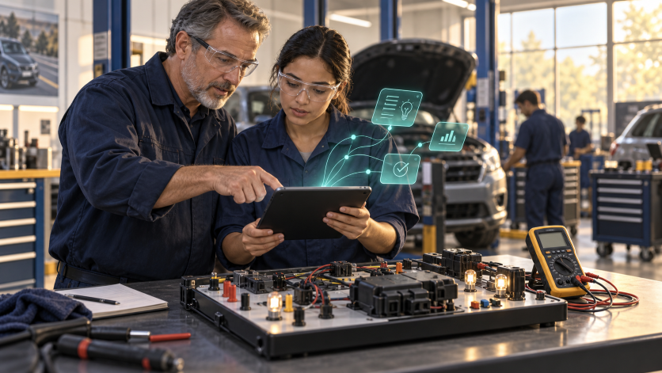
Consider a technician who leaves an electrical diagnostics class confident, then struggles to apply voltage-drop testing three weeks later. For a technical training manager, that gap is an opportunity: extend the lesson into the weeks when knowledge must become working judgment.
AI can help strengthen that connection. Keep instructor-led classes, hands-on labs, OEM coursework and observed skills assessments. Add AI to help instructors draft practice cases, deliver targeted refreshers and spot recurring misconceptions. The instructor still teaches the method and verifies competence; AI helps carry the learning between sessions.
Start with one familiar course. After an electrical lab, have AI draft variations of an approved case involving high resistance in a loaded circuit. Ask technicians to explain their next test and predict what its results would mean before revealing feedback. An instructor checks each case against current service information. Deliver these approved refreshers through your existing learning platform before piloting a live assistant. The aim is more opportunities to reason through a fault, with practice tied directly to the original lesson.
Build a repeatable pipeline: identify a learning gap, assemble approved sources, develop a small pilot, validate it, measure results and decide whether to expand. Assign a training owner and involve an instructor, a working technician and IT. Keep a backlog of new AI capabilities, but advance each only when it addresses a defined training need.
Use version-controlled lesson materials and service information approved for use in your chosen AI environment. Record vehicle applicability and revision dates; remove customer identifiers from repair examples. Require generated explanations to cite their supporting source. If the source is missing or conflicting, route the question to an instructor. Source access alone does not guarantee a correct answer.
Before release, test realistic questions, misleading prompts and cases with insufficient information. Set approval criteria and recheck the tool when its model or source materials change. NIST’s Generative AI Profile provides a useful framework for addressing risks such as confidently fabricated information. Keep safety-critical procedures and final competency sign-offs under qualified human control.
Retention depends on what learners do. The Institute of Education Sciences practice guide recommends spacing learning over time and using quizzes to revisit key content. These findings support the learning approach; they do not establish that AI improves automotive training by itself.
Try a five-minute refresher two days after class, another the following week and a new application case a month later. Treat that schedule as a pilot, adjusting it to results. Have technicians retrieve the reasoning before seeing an explanation, then revisit missed concepts using approved examples. Reserve paid learning time so reinforcement survives the demands of the service drive.
Design the assistant to offer hints before answers. A 2025 randomized study in high-school mathematics found that unrestricted AI assistance could undermine subsequent unaided performance; a tutor with learning safeguards mitigated that effect. Automotive teams should test that design principle locally rather than assume the same outcome.
Judge the pilot by delayed knowledge checks and instructor-observed diagnostic performance without AI assistance, alongside preparation time and review effort. Where practical, compare with a similar group receiving the existing course. Track repair outcomes cautiously: job mix and experience affect them too. Expand when technicians demonstrate stronger independent performance and the workload is sustainable.
Podcast - How AI Fixes the Auto Technician Shortage
Samples